
Montgomery Deed Records and Instruments
The Montgomery County Circuit Court Clerk records land instruments and opens them to public inspection. A deed documents a conveyance between named parties. Other instruments do different work. Some create, assign, modify, or release a lien, while others simply describe a parcel. The county's list runs long: deeds, deeds of trust, refinanced and credit-line deeds of trust, assignments, plats, easements, powers of attorney, satisfactions, homestead deeds, foreclosure deeds, covenants, and restrictions.
| Deed Type | What It Does | Common Use |
|---|---|---|
| Deed | Records a conveyance and its parties and legal description. | Confirm a filed transfer and link to prior deeds. |
| Deed of trust | Records borrower and trustee roles for secured financing. | Trace a loan instrument; it is not a deed of ownership. |
| Assignment | Records a transfer of a lender's interest. | Follow a bank or beneficiary change in the record chain. |
| Certificate of satisfaction | Records a release tied to an earlier deed of trust. | Check whether a referenced security instrument was released. |
| Plat or easement | Shows a recorded land layout or granted access right. | Read a lot, right-of-way, access, or shared-use reference. |
Deeds of trust, assignments, and liens sit beside deeds in the same land-record system, yet each carries a different legal role. Names can mislead. A borrower is not always a later grantor. A trustee is not the new owner. An index row alone proves nothing, so read the instrument type and the full legal description before drawing any conclusion.
Logan Access and Montgomery Deeds
The Clerk works with Logan Systems for electronic scanning and indexing. Many documents can be viewed or printed through a subscription. The county cautions that not all documents are online. A non-subscriber must visit the Clerk's office instead. The county publishes no earliest indexed year and no guaranteed image cutover. An absent online image therefore proves nothing about whether a deed was recorded. Use the Logan Systems portal to check current access terms. The subscription boundary matters most with an older deed. A plat, satisfaction, or assignment may be needed to resolve a chain. Keep the parties and instrument number from any index hit. Then ask the Clerk for the full record.
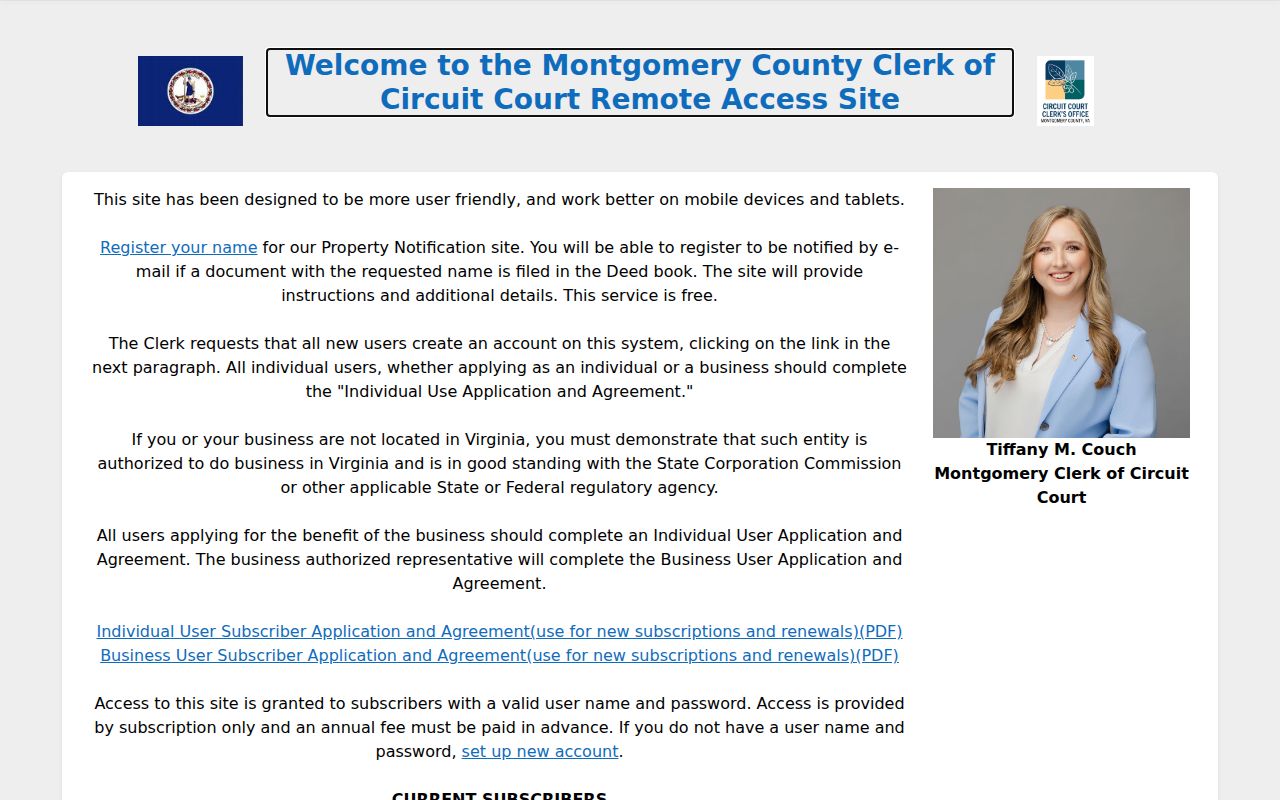
The portal's landing page displays the access route for Montgomery County land records. Coverage dates vary by document inside the live system.
Montgomery Grantor and Grantee Search
The county's Clerk page posts practical indexing rules. Search full party names, and include a suffix when one is indexed. A land description should match the instrument itself. The copy-request form accepts a person's name, book and page, instrument number, a short description, and a copy count. Those same reference types help a reader report a specific result to the record room. Precise references speed up any copy order.
| Search clue | How Montgomery indexes it | Why it matters |
|---|---|---|
| Corporation | Enter the complete name in the last-name box without punctuation. | A punctuation change can hide an entity match. |
| Trustee | Use “TR” as a suffix when the Clerk's instructions call for it. | Trustee names may be indexed apart from borrowers. |
| Land description | Use town or district, not both; include subdivision, lot, phase, section, or acreage. | The description can connect an older deed to a present parcel. |
| Instrument reference | Use book/page or instrument number from a related record. | Assignments and releases often cite an earlier filing. |
The table follows the Clerk's published indexing guidance and copy form. It does not list every live portal filter.
The Montgomery Grantor-Grantee Index
A grantor conveys an interest. A grantee receives it. They often match seller and buyer. In a purchase deed those roles usually line up neatly, but a deed of trust uses different roles, so the same search pattern cannot be applied blindly. To follow a chain, start from a known current deed, identify its grantee, and search backward to the instrument naming that party as grantee.
- Find the deed that names the present grantee and record its date, parties, land description, and reference number.
- Read the grantor on that deed. Search that person or entity as a grantee to find how they acquired the land.
- Repeat one transfer at a time, matching the legal description and any book/page or instrument number cited.
- When an index entry has no image, or a name chain stops, ask for courthouse inspection and older deed-book or plat references.
- Grantor
- The person or entity shown as giving the recorded interest.
- Grantee
- The person or entity shown as receiving the recorded interest.
- Chain of title
- The ordered trail of recorded transfers tied to one parcel.
- Book and page
- A volume and page reference to a recorded instrument or plat.
- Instrument number
- A separate reference accepted by the Clerk's copy request form.
Deeds of Trust and Ownership
A deed of trust is a security instrument. It does not name a new fee owner. Montgomery County's Clerk indexing tips direct a searcher to list the borrower or borrowers as grantors and the first trustee as grantee, with “TR” in the suffix box. A search that treats the trustee as a buyer can distort the chain.
Assignments and satisfactions add more role changes. In an assignment, the borrowers and the assigning bank may appear as grantors, while the new bank shows up as grantee. For a satisfaction, the borrowers and first trustee can be indexed as grantors, with the borrowers again as grantees. Use the original deed-of-trust book and page or instrument number to link these records together. A satisfaction is a release indicator worth verifying. It is no excuse to skip the original instrument.
The same role-aware method covers a substitute-trustee instrument. The Clerk's notes place signers and non-signing borrowers on the grantor side, with the new trustee as grantee. Follow the roles. That filing alone does not prove a foreclosure sale occurred.
Request a Montgomery Deed Copy
Copy pricing at the Clerk's office runs 50 cents per page for the standard sizes. Plats bigger than 11 by 17 cost $2 per sheet. Mail requests go on the county form. It asks for a name, the book and page or instrument number, a short description, and how many copies you want. Make checks or money orders payable to Clerk Tiffany M. Couch. Paying by card over the phone requires a number noted on the form. It carries a 4% convenience fee. Remember the self-addressed stamped envelope.
The form's checkboxes span marriage, criminal, and civil. They also cover deed or other land record, will book record, and other. For a land document, give the strongest party and instrument clues you have. Counter hours run Monday through Friday, 8:30 a.m. to 4:30 p.m. Recording is accepted until 4 p.m. The land-record room answers at extension 5, 540-382-5760.
The Clerk's land-record page lists the record types, inspection hours, and fees. For an identified record, the copy request form lays out the fields and payment route. It is not a substitute for a full title search.
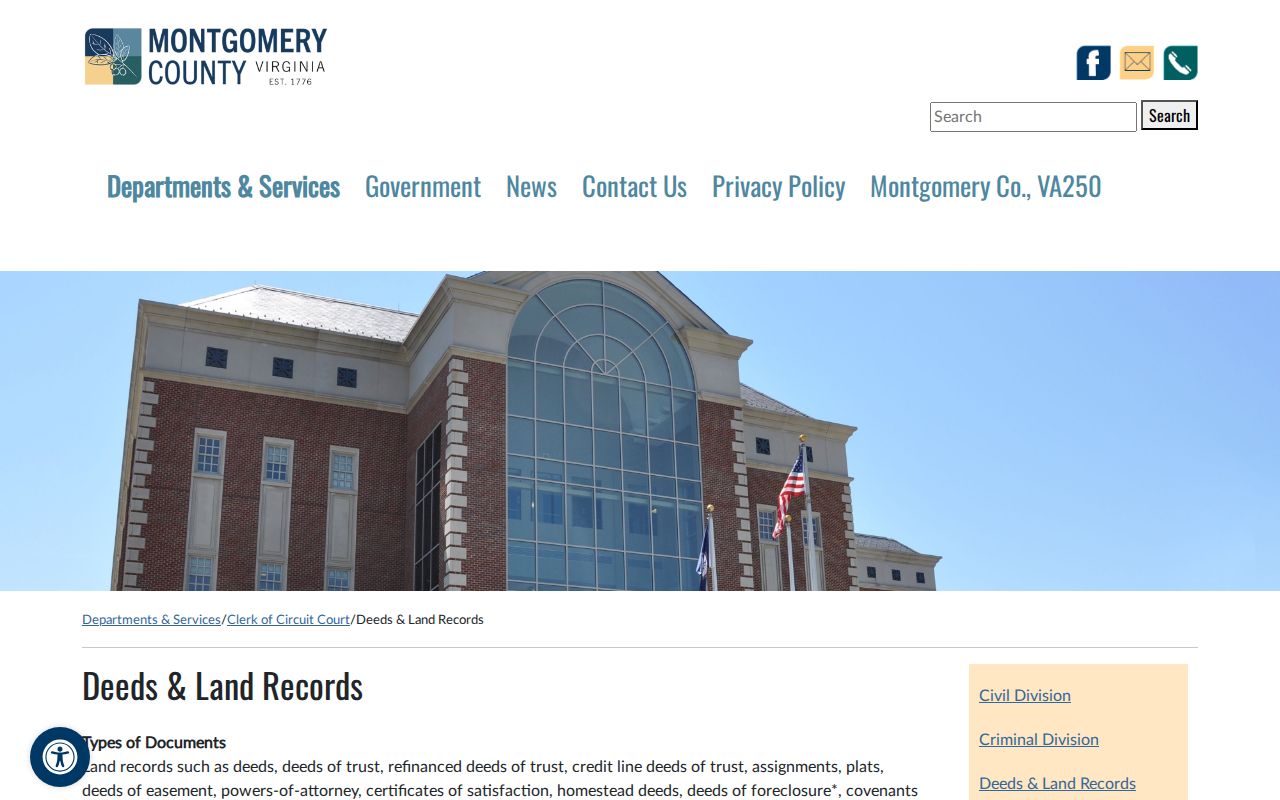
Check the Clerk page for published record types. Confirm current counter details before any visit.
Virginia Remote Land Records
Virginia's Secure Remote Access to Land Records is known as COVERS or SRA. It opens a statewide door to records held in participating Circuit Court Clerk systems. The state terms describe what Clerk offices provide through COVERS. Yet they also state that the online information is not the official judicial or administrative record. Montgomery County points readers back to its Clerk as the official access point. Remote access does not guarantee that every local image appears online.
Treat SRA as a second path. It may surface a land-record index worth pursuing. But confirm the instrument with the local Clerk before relying on it. An image can be restricted. An entry can be missing. In that case, check the Logan access terms or request in-person inspection. Keep county, parties, recording date, and instrument reference together as you compare portals.
Virginia Circuit Court Secure Remote Access publishes the statewide terms. The public access route shown there is not a promise of a complete Montgomery image set.
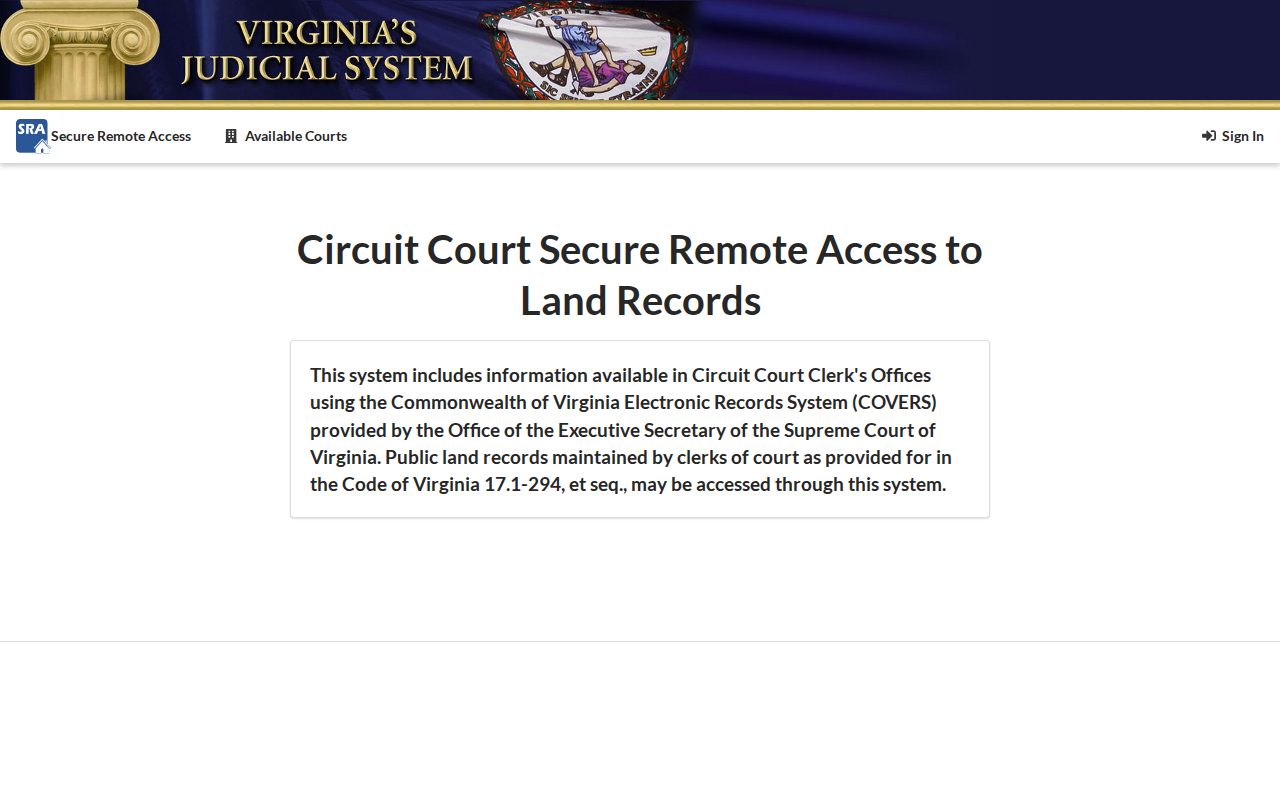
If the statewide view and the local record ever differ, trust the Clerk's official instrument copy.
Montgomery Foreclosure Deeds
The Clerk records deeds of foreclosure. That is the extent of it. The office gets no advance notice of properties in foreclosure. It runs no auctions. It sells nothing on the courthouse steps. An online deed search can turn up a foreclosure deed recorded after the fact. But it is not a list of pending auctions. For a specific property, the Clerk suggests a record-room search. Use the address along with the current or former owner.
Timing questions go to the trustee, bank, or auctioneer named in the notice. Search the land index for the original deed of trust. Look for any assignments, substitute-trustee filings, and later deeds. Then compare legal descriptions and parties. Tax delinquency belongs to the Treasurer. A court docket may hold litigation or a quiet-title filing.
A substitute-trustee document alone does not mean ownership changed. You need the later instrument and its recording data to establish what was actually filed.
Getting a Montgomery County Deed
A recorded instrument can be reached three ways. Logan works when the image is available. Public inspection in the courthouse record room is another route. A mailed request on the Clerk's copy form is the third. Say which copy type you need. Include a name, book/page, instrument number, brief description, and copy count. The Clerk page posts regular-copy prices, and the form explains mail payment. The county sets no universal online cutoff. It does not promise that every historical image is remote.
When an older book or plat is missing from Logan, ask the Clerk for guidance. Then try the Library of Virginia and the Montgomery-Floyd Regional Library for archival or local-history leads. Keep each reference and date intact as you work backward. A missing web image may simply mean the record is offline. It may be absent from that portal. That does not prove a transfer never happened.
Recorded, not guaranteed. Montgomery County deed records show filed instruments, not a guarantee that every interest has been found or that title is clear. A full title review requires a complete professional search.