
Trace Former Montgomery County Owners
Start from a transfer you can already name. From there, walk the chain backward. The Circuit Court Clerk records deeds and other land instruments. Logan Systems scans and indexes many of them for the county. Not every item is online, though. The county has posted no earliest indexed year and no guaranteed image cutoff. When a deed chain stops online, the physical deed books, plat references, and archive catalogs take over.
| Source | Coverage stated? | Where held | Use in a chain |
|---|---|---|---|
| Clerk / Logan land index | No start year or cutoff published. | Logan subscription portal and courthouse record room. | Recorded deeds, parties, liens, plats, and related instruments. |
| Deed and plat books | Ask Clerk staff for the needed volume or series. | Courthouse record room; some historical series may be elsewhere. | Older transfers and legal descriptions not found online. |
| Library of Virginia | Depends on the transferred record series. | State archives and catalog. | Retention, historical county records, and finding aids. |
| MFRL local history | Catalog coverage varies by collection. | Montgomery-Floyd Regional Library. | Local genealogy and cemetery context, not title proof. |
Search the deed index for recorded transfers first. Follow the reference trail from there. An archive or library can supply older county material and historical context. The MFRL cemetery atlas may tie a family name to a place, but it cannot establish ownership.
Walk the Montgomery Deed Chain Backward
In a backward chain, the grantee on each deed is the key. Record enough detail to tell parcels apart. The dates matter too. A deed often cites a prior book and page or instrument number, and that citation is a direct clue to the next document in the chain. Keep names, dates, instrument type, and land description in one table as the chain grows.
| Latest deed | Copy the recording date, grantor, grantee, deed type, and book/page or instrument number. |
|---|---|
| Prior acquisition | Search the current grantee as a grantee to locate how that owner acquired the parcel. |
| Earlier transfer | Read the prior deed's grantor, then search that name as a grantee. |
| Parcel link | Compare legal description, acreage, subdivision, lot, and cited references. |
Stop when a document no longer matches the same land. One person can own several parcels, and a modern address may never appear in an older deed.
Montgomery Index Roles Matter
The Clerk's local indexing tips help you avoid false ownership links. For a deed of trust, search the borrower or borrowers as grantor. Use the first trustee as grantee, with “TR” in the suffix box. For an assignment, the borrowers and the assigning bank can both serve as grantors. The new bank is the grantee. A satisfaction is different. The borrower and trustee roles may appear on both sides. That pattern reflects release, not a sale.
Enter a corporation in full in the last-name field, without punctuation. The description can use town or district, but not both. It should include subdivision, lot, phase, or section when known. For a map, the owners are entered as grantor and grantee. The description is the map description. These details matter whenever a plain name search fails to reveal a linked record.
Borrower, trustee, bank, and property owner are different roles. Read the recorded instrument itself. Do not count every index row as a transfer of title.
Use the Montgomery Grantee Index
Use the assessor only to identify the current parcel and its owner field. Then search the Clerk's index for that grantee's deed. Read the grantor name and the legal description straight from the instrument. Search the former grantee's name in turn. Follow any book/page or instrument reference until the chain reaches a point that calls for older books or archival research.
- Identify the parcel and the latest deed that names the present owner as grantee.
- Write down the grantor, grantee, recording date, document type, and land description.
- Search the grantor as a prior grantee and compare the old deed's parcel description.
- Repeat through linked instruments; ask the Clerk for an older volume if the online chain ends.
- Grantor
- The party who conveys the stated interest.
- Grantee
- The party who receives the stated interest.
- Chain of title
- The ordered sequence of recorded transfers tied to the same land.
- Legal description
- Land wording that can survive a change in street address.
Montgomery's Online Cutoff Is Unknown
The Clerk's land-record page states neither the earliest year indexed nor a precise image cutover. Logan access is subscription-based and incomplete. Do not write a year into a chain plan. The Clerk must confirm it for the series you need. An index may reach further back than the image files available to a public user.
Note the party names and the type. Record the book/page or instrument number and the description too. Then ask the record room about the original. It may sit in a deed book, a plat book, on microfilm, or in another collection. Non-subscribers must come to the office. The Clerk requires that for records not available online.
Montgomery County has no known courthouse fire, destroyed decade, or lost deed-book run. Treat the unknown web cutoff as unknown. Do not turn it into a claim that records were destroyed.
The Logan Systems land-record portal is the online index route. It offers subscription access and incomplete image coverage. Its landing page is the starting point. Check there whether a former-owner instrument is available remotely.
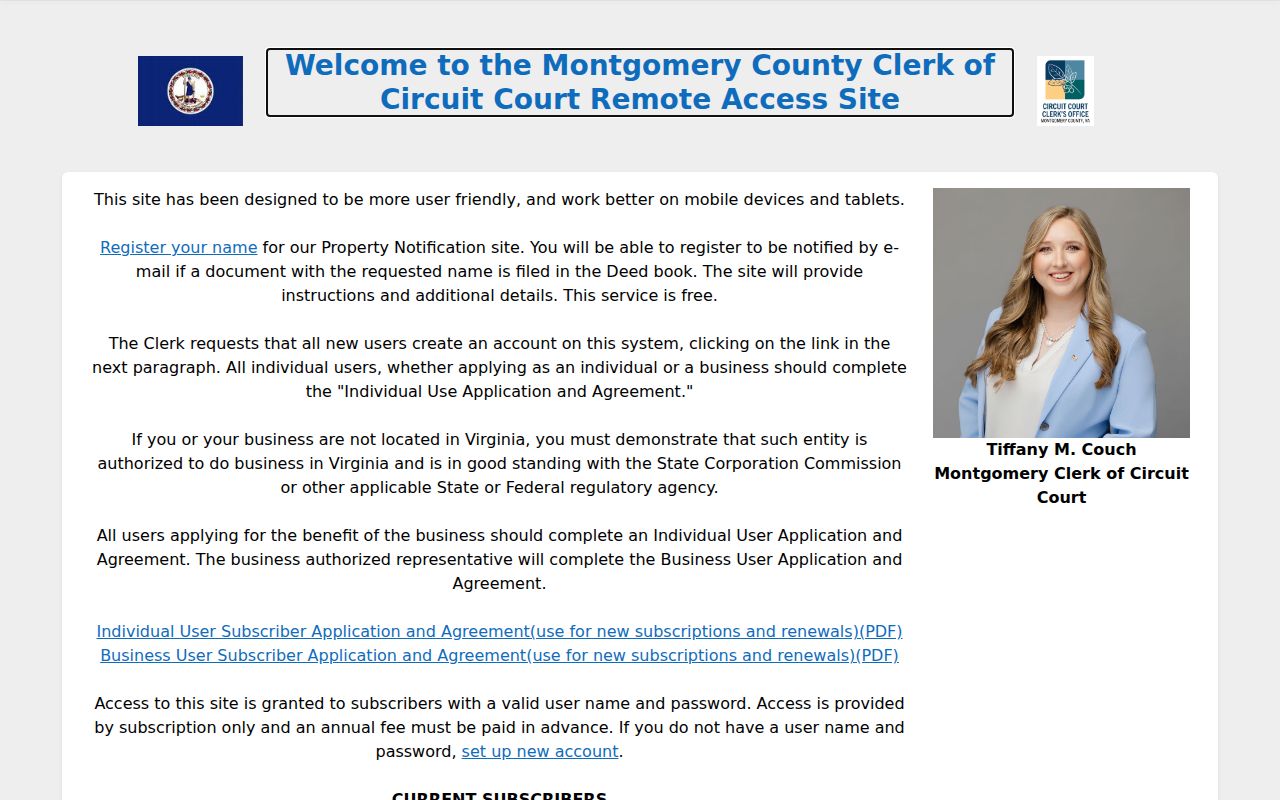
Record the instrument reference and the parties even when the image will not open. Then ask the Clerk about inspection.
The Circuit Court Clerk's land-record page lists record types, public hours, and copy fees. It serves as the local fallback for a deed image. It also covers an older book not found online.
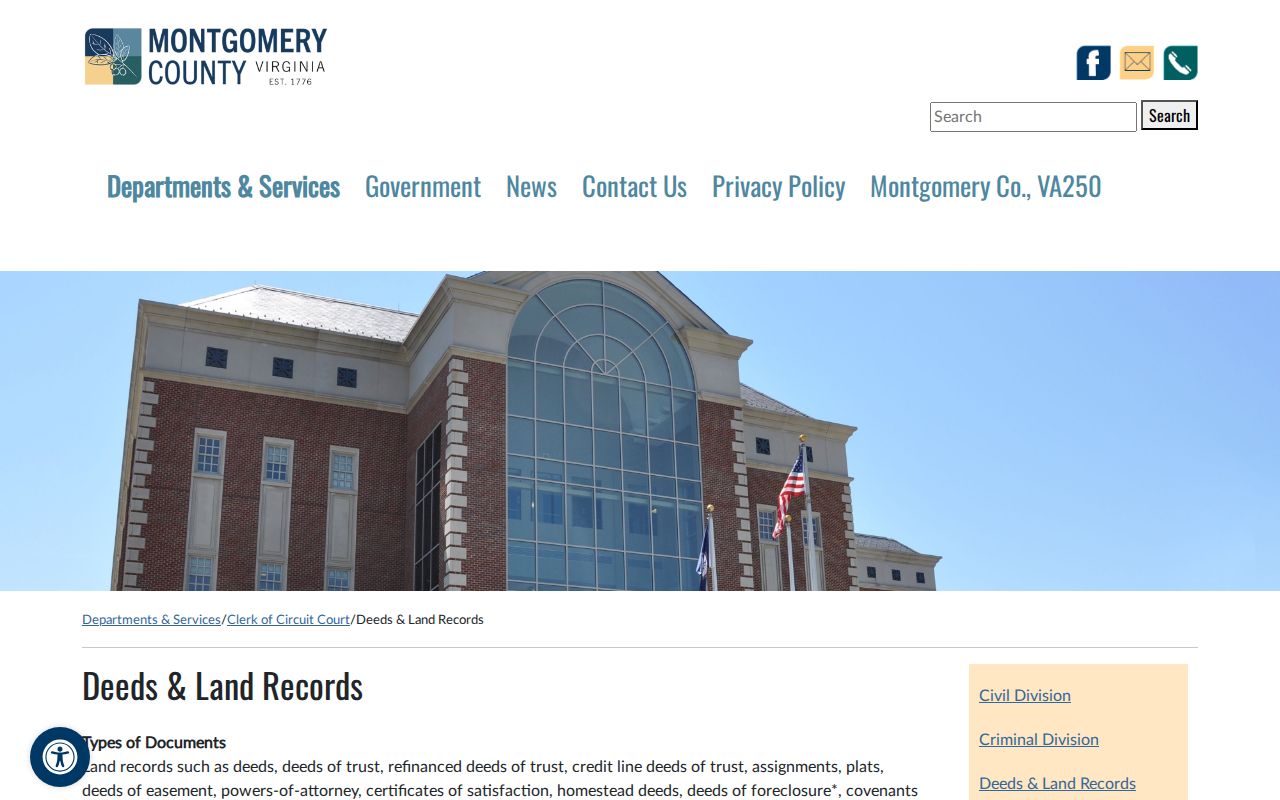
Give the record room names, dates, book/page or instrument number, and a land description. Those details narrow a historical search fast.
Montgomery Deed Books and Archives
Start any historical land search with the Circuit Court Clerk. That office holds the deed books, grantor and grantee indexes, plat books, survey references, releases, and partition records. Finding aids sit in the record room too. Older series sometimes moved under Virginia retention schedules. When that happens, county guides can point to the right archive. The Library of Virginia catalog helps as well.
Virginia's Public Records Act sets the retention rules. Pre-1912 records carry a special offer-to-the-Library provision. The Library does not replace the Clerk's current record room. It serves as a fallback for transferred or historical series. Montgomery-Floyd Regional Library offers another local history lead, especially for genealogy and its cemetery atlas.
The Library of Virginia catalog is the route into older county records. The image shows the archive entry point rather than any specific Montgomery deed-book year.
Use a catalog result to spot a record series. Then confirm its coverage and access terms before relying on it.
Probate Can Break a Name Chain
Land titled solely in a decedent's name may need probate. Probate explains who could transfer it. The local probate handout lists real estate deeded only in the decedent's name. That makes it a probate matter. Trace the decedent's acquisition deed first. Then follow the probate file for a will, executor or administrator, heirs, debts, and any court-approved sale. Return to the land records next. Look there for the deed of distribution, commissioner's deed, or other filed transfer.
A joint tenancy, survivorship term, or beneficiary arrangement can move an interest. It can shift ownership outside a simple sole-name probate file. The assessment roll will not explain that legal path. Search the exact estate, fiduciary, and grantee names that appear in each record.
Virginia Vital Records runs statewide birth, death, marriage, and divorce certificate services. The office publishes no reliable guide to current eligibility periods. So follow the state's access rules as they stand. Certificates are not a shortcut around the deed and probate trail.
Virginia Vital Records explains the state access route. The page serves as family-history context, not as proof of title.
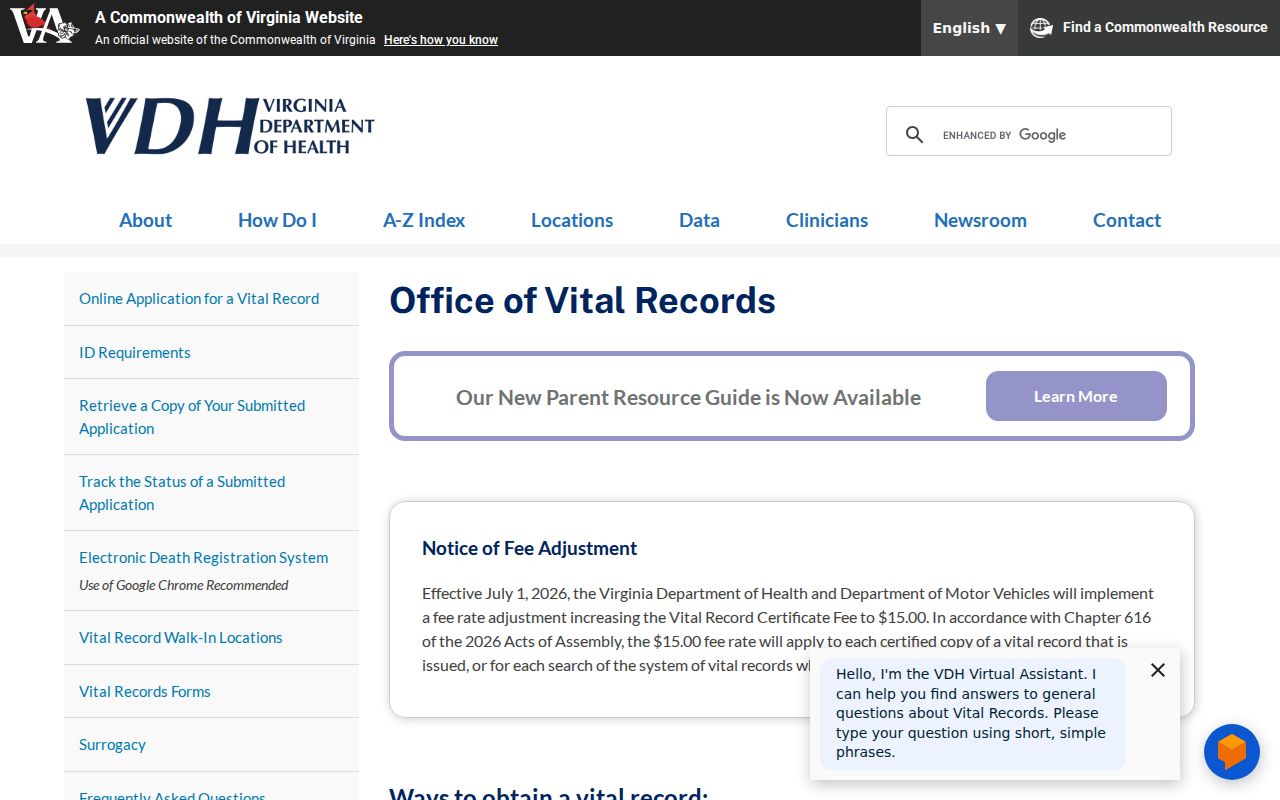
For a transfer, return to the county deed and probate files once a family-history lead appears.
Old Montgomery Land Descriptions
An older conveyance may describe a tract by acreage, district, road, or adjoining owner. It may also name a farm instead of a modern street address. County GIS now manages E911 site addresses and street names. That helps bridge older land calls to current map geography. Search the parties and the legal description together. Then use a plat to connect a parent tract with later lots or phases.
Montgomery Clerk indexing instructions call for town or district, not both. Include the subdivision name, lot, phase, section, or acreage when present. A road known by a later name may need more than one search key. A tract divided after the original deed may too. Never assume a current tax-map ID existed when the old transfer was recorded.
Blacksburg's population grew from 9,384 in 1970 to 30,638 in 1980, then 44,826 in 2020. That growth is a reminder. A rural description can sit inside a present town address. It is not evidence of any specific annexation.
How Far Back Montgomery Records Reach
The Clerk publishes no starting year for online deed records. No courthouse fire or missing decade is on record. A chain may continue in a courthouse volume. It may also sit in a transferred archive or a local history collection. Ask for the record series and its coverage. An online gap does not mark the end of ownership history.
Montgomery-Floyd Regional Library's genealogy sections include a special cemetery atlas. The county GIS office also worked with Virginia Tech Appalachian Studies partners to map family burials and cemeteries. Those names can orient a historic search. A cemetery location proves no owner or boundary, though. Keep the deed and plat as the evidence of transfer.
The Montgomery-Floyd Regional Library is a local history lead. Ask staff to confirm catalog coverage and call numbers before drawing a chain from an index mention. Do this for a particular family or parcel.

Use family and cemetery sources to find names or places. Then verify each transfer in the Clerk's land records.
Lawful use. Use Montgomery County former-owner research for house history, family history, and property diligence. Do not use a chain of names to track or harass a living person.